

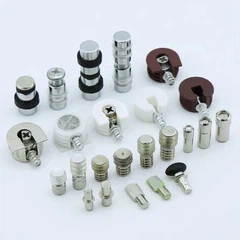

At present, China's fastener industry is facing a reshuffle and transformation, with continued overcapacity and declining fastener sales, and some companies are under increased pressure to survive. The healthy development of a fastener enterprise must establish the core competitiveness of the enterprise and cultivate the internal driving force of the industry, but at present, most fastener enterprises in my country lack advanced technology due to insufficient innovation ability, lack of intellectual property rights, and lack of technical personnel in the enterprise. .
In recent years, with the sustained, stable and rapid development of my country's economy, my country's fastener industry is constantly overcoming various difficulties, grasping the domestic market, relying on major emerging industries such as automobiles, high-speed rail, shipbuilding, advanced manufacturing, IT and electronic appliances The development of the company has always focused on innovation and transformation, and unremittingly adjusted the product structure, so that the fastener industry has achieved a steady and rising trend.
In terms of total sales and output, the total sales of China and Japan are close to 9.375 billion US dollars and 9.69 billion US dollars respectively, but the total sales are 6.2 million tons and 2.87 million tons. That is to say, the tonnage of fastener products exported by my country is the largest, but the added value is the lowest. Therefore, we must work hard on the added value of the technical content of the exported products. The reason for the substantial increase in exports year-on-year is that in 2009, affected by the financial crisis and EU anti-dumping, my country's export volume of fasteners was the lowest in history, only 1.61 million tons. Feng Jinyao explained.
After several years of industrial transformation, adjustment and reorganization, the rapid development of the Korean fastener industry has shocked him. He has visited two Korean factories, one of which has more than 200 employees and its sales are 600 million yuan, that is, the per capita labor productivity is 2 million yuan, and the other company's more than 300 employees have created more than 1 billion yuan of sales, which means that the per capita labor productivity is 2.5 million yuan. Almost all of the workshop is automated production.
At the same time, high-strength, non-standard special-shaped products have also developed rapidly, which is close to 60 percent of the total market. Greatly improved the industry's average product price in 2011. Specialization is the way our industry is going. In the first step, I hope that enterprises can increase the per capita labor productivity to RMB 500,000 to RMB 1 million. Only when it exceeds RMB 1 million can companies have the ability to participate in market competition. Feng Jinyao said.
Is féidir a rá go bhfuil forbairt an tionscail ceanglóir le cúig bliana anuas measctha. Is é an dea-scéal ná go bhfuil an tiúchan tionsclaíoch méadaithe, tá fiontair tosaigh tar éis fás tapa a choinneáil, agus tá fiontair le níos mó ná 1 billiún yuan tagtha chun cinn, mar shampla Jinyi agus Changshu. agus roinnt fiontair le luach níos mó ná 500 milliún yuan; agus beagnach 200 fiontar le luach os cionn 100 milliún yuan. Ach ag an am céanna, is cúis imní é go bhfuil go leor fiontair micrea agus fiontair bheaga scaipthe, le luach breise íseal táirgí, ró-acmhainn, agus go leor fiontair ag dumpáil ar phraghas íseal, níl an margadh caighdeánaithe go leor, agus tá iomaíochas na bhfiontar. ní láidir.
Is é an rud is tábhachtaí d'fhiontar ná a éifeachtúlacht chomhrac a fheabhsú, aird ghéar a thabhairt ar cháilíocht, agus bealach ardchaighdeáin a ghlacadh, agus is é speisialtóireacht, speisialtóireacht agus cruinneas an t-aon bhealach chun fiontair ceanglóir a fhorbairt. .